Filanda Palace
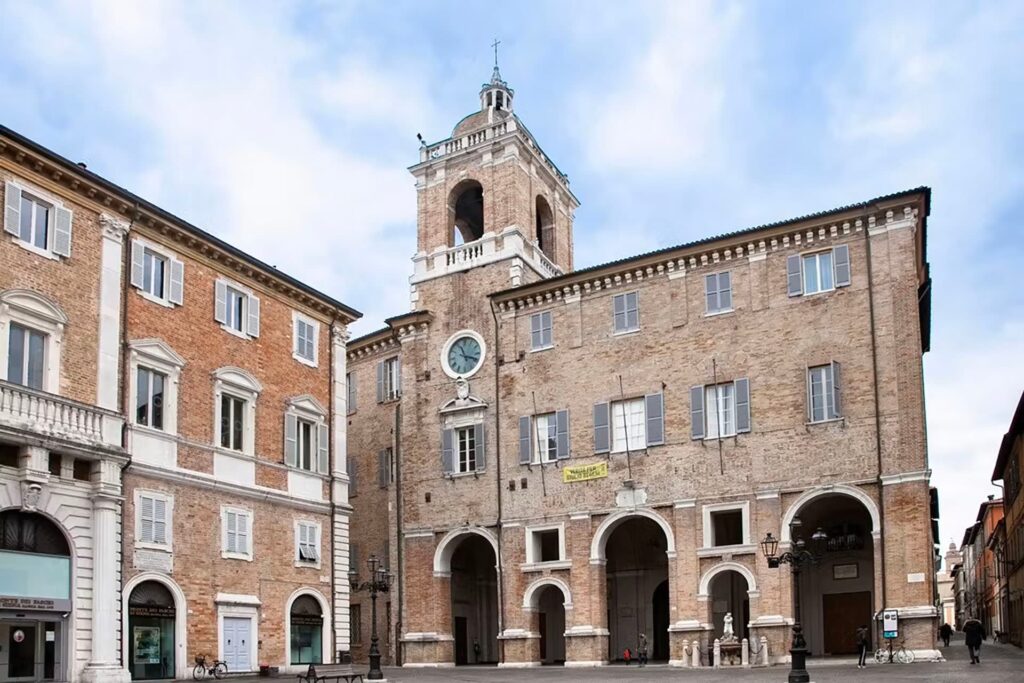
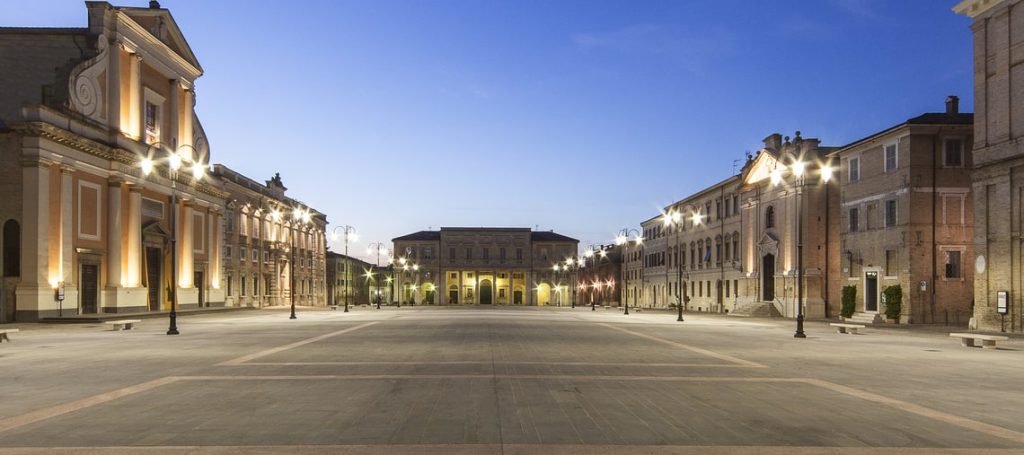
Designed by architect Ghinelli, the imposing island-shaped Palazzo della Filanda is supported on its four sides by porticoes in white Istrian stone identical to those built along the canal.
The history of the Palazzo della Filanda began in 1758 when the General Council of Nobles decided to donate the Antonelli family, whose members had worked so hard to obtain authorization from Pope Benedict XIV to expand the city, the area on which to build their own palace.
However, about half a century later, not a single brick having been laid, in 1805 the municipal judiciary asked the card. Leonardo and Count Bernardino received the restitution of the land, which was donated to Vincenzo Micciarelli of Jesi, who had undertaken to build the magnificent, imposing island palace there, designed by architect Pietro Ghinelli, supported on its four sides by porticoes in white Istrian stone identical to those built along the canal. Work began immediately after the 1805 fair, but due to an unexpected serious financial crisis suffered by Micciarelli, the work continued for almost thirty years until, unable to complete the work, Micciarelli was forced to sell it to Count Lovatti of Rome, who quickly completed the building.
It is curious to remember that in August 1818, to facilitate the completion of the works, the Municipality held a large lottery to raise the necessary funds, which, however “was postponed due to lack of shares”, but nothing more was done.
As evidence of the majesty of the building, it is sufficient to remember how in 1829 to prevent the city, and in particular its famous fair, from being left without the usual opera performances in that year if the new theatre that the Community was building in place of the old condominium used until the previous year was not ready, The Civic Administration immediately built a wooden theater in the courtyard of Palazzo Micciarelli. It had three tiers of boxes with 21 boxes for each tier, a gallery, stalls, atrium, dressing rooms, and everything else needed to perform opera and dance. It began operating regularly and operated until the following year, when the new theater opened.
Then the palace changes hands. A certain Corrado Hoza takes it over and transforms it into a silk mill. The activity continued from 1867 to 1930, the year of the earthquake.
Where
Contacts
Address
Piazza Garibaldi
Other Information
Categories
Storico
You might also be interested
Senigallia Turismo Digitale - CUP H17H24001440006 - Questo intervento è stato realizzato con il contributo di 45.000€ dell’Unione europea Bando POR FESR Marche 2021-2027 - Asse 1 - Azione 1.2.2 - Int. 1.2.2.2 Bando per “Servizi digitali integrati”



